|
THE
STORY OF HIS SURVIVAL
The events of November
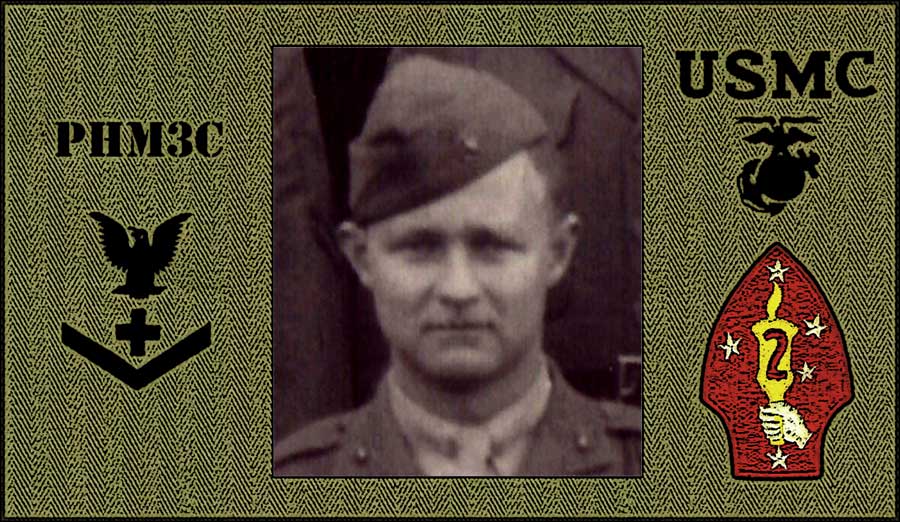
21 and 22, 1943 would be PhM3c Clinton L. Hoatson's first and last
combat experiences. He had joined the 1st Battalion 6th Marines in New
Zealand, after they had returned from Guadalcanal. The Marine assault
on Betio Island, Tarawa Atoll, British Gilbert Islands, would be
his first experience in combat.
Just as darkness was beginning to fall, on the evening of 21 NOV 1943 (D+1), Corpsman
Hoatson was part of a battalion landing on the southern part of Green Beach, at the
southwestern end of Betio Island. Hoatson, and about seven other Corpsmen and Marines,
were paddling toward the beach in a small rubber boat. Hoatson and his companions
had transferred to the rubber boat from a larger Higgins Boat, which had been launched
earlier that day from the USS Feland. They were surrounded by large numbers of identical
rubber boats, carrying hundreds of other Marines from the 1st Battalion, 6th Marine
Regiment.
The western shore of Betio, called Green Beach, had been occupied earlier by other
Marines, and the 1st Battalion, 6th Marines did not encounter any direct fire from
the Japanese defenders as they began their rubber boat landing.
As Corpsman Hoatson and his small group paddled toward the shore, their rubber boat
began to leak air and sink. One of the two LVT(1) amphibious tractors, that had been
launched earlier from the USS Feland, stopped and rescued Hoatson and his companions
from their sinking rubber boat. This LVT(1) then continued toward the beach.
When the LVT(1) had traveled about a hundred yards or so toward the beach, the water
became about waist deep. At this point, many of the nearby Marines could be seen
getting out of their rubber boats and pushing them on toward the beach. It was in
this general area that Hoatson's LVT(1) struck the Japanese boat mine. The resulting
explosion blew the bow off the LVT(1) and turned the heavy vehicle completely upside
down in the water.
Nearby Marines and Corpsmen converged on the wreckage, after Hoatson
was heard calling for help. Hoatson had suffered a fracture of his right leg.
All the other occupants of the LVT(1) had been killed by the explosion.
The other LVT(1) from the USS Feland came to the scene of the explosion,
and stopped to assist. Arriving Corpsmen and Marines put Hoatson
in a stretcher and placed him on the rear deck of the second LVT(1).
This LVT(1) made it to shore and parked on the beach, in the narrow
area between the water's edge and the seawall. This was in a location
just north of the large 8-inch gun emplacement at Temakin Point,
at Betio's southwest corner.
Hoatson had been treated by members of his own medical unit, and his right leg, from
the hip down, had been placed in a large metal splint. Still tied to his stretcher,
he was left in the LVT(1) for the night, to await evacuation on the following day.
Three of his fellow Corpsmen spent the night in a large shell hole nearby, sharing
it with the remains of two Japanese soldiers.
At about 0400 hours on the following morning, 22 NOV 1943, Hoatson was still in the
LVT(1). The tractor's crew chief was awake and standing armed watch in the cargo area
of the LVT(1). A Japanese bomber suddenly appeared and dropped a string of bombs along
the southwest corner of the island. One of these bombs landed at the front of the
LVT(1) and another alongside it. The LVT(1) was disabled, and the crew chief and Hoatson
were blown out of it, and onto the beach. The crew chief was gravely wounded and
narrowly escaped death. No one thought he would survive long enough to be evacuated,
but today he is 85 years old, doing well, and living in northern Illinois.
Hoatson was found on the beach, still in his stretcher, by the three Corpsmen who
were spending the night down in the shell hole. They pulled him down into the hole
with them, to protect him from further injury. Amazingly, he did not appear to have
suffered any additional injuries from the exploding bombs.
Later in the day, Hoatson was placed in another LVT and evacuated out to one of the
troopships. One of the Corpsmen notes that Hoatson was a little apprehensive about
trusting his luck to yet a third LVT. Hoatson's luck was holding though. Shortly
after being safely taken aboard the troopship, he discovered that one of the Corpsmen
working in his ward was a high school friend from his hometown of Sutherland, Nebraska.
This would be the end of the war for Corpsman Hoatson. After a lengthy hospital stay,
he was discharged due to his wounds. He would live to be 80 years old, and die in
Florida.
Jim Hildebrand
January 20, 2006
Updated August
18, 2020
(Read
Sgt. Smiley's account of how his LVT(1) picked up PhM3c Hoatson.)
(Read
PhM2c Schaff's account of how corpsmen provided medical treatment.)
-----------------------------------------
ADDITIONAL INFORMATION
PhM3c Hoatson was taken off Green Beach and out to
the USS Doyen on 22 NOV 1943. There is where he met up with his
friend from Sutherland, Nebraska, PhM1c Walter J. Jochum, who
helped with his treatment.
PhM3c Hoatson stayed aboard the USS Doyen and was
transported to the US Navy Hospital at Aiea Heights, Hawaii. He
was then transferred from that hospital to the USS Solace on 17
DEC 1943 and transported to San Diego, arriving about 23 DEC 1943.
Jim Hildebrand
August 04, 2012
|